
RightNow Writing 1.0 had to pass a test we could fail
, 9 min read, By RightNow AI
AnnouncementRightNow Writing 1.0 is a tested writing layer on our API, called rightnow-writing-1. It is meant to write like a careful person, without the habits that give machine text away.
It had to pass a bar we wrote down before any answer existed. One version failed that bar and we threw it away. The version that passed then failed a different test, the night before this post.
The bar
The bar compares Writing 1.0 with the same model with no writing prompt. Three AI judges read both answers to 40 everyday requests blind, with the order balanced for each judge.
Two of the three had to prefer Writing 1.0 on at least 28. Counted habits had to fall at least 60 percent, and accuracy on 20 fact questions and 20 format instructions could not drop.
We wrote eleven versions of the instructions. Version 9 failed the bar on 22 November. Its email asking for a day off came back too bare to send, and its chat answers kept falling into lists of three. We threw it away. Version 11 passed later that day. It is the text you call today.
The test it failed
All dates and times in this post are UTC.
At 04:02 on 23 November, with version 11 live, we asked for about 350 words, 24 times, one call at a time, with a limit of 1,000 output tokens. That is an ordinary limit. 10 of the 24 answers came back empty.
The model thought for 942 tokens at the median before it wrote. That thinking is not returned, and on 10 calls it used up the whole limit. Where text did arrive, the first visible word took 3.5 seconds at the median. Every earlier writing test had used a limit of 3,000 tokens, so none of them showed it.
The fix was to turn thinking off unless the caller asks for it. Before making that the default, we ran the bar again on that setting, with the instructions unchanged and the rule fixed before any judge read a pair.
Two of three AI judges picked Writing 1.0 on 38 of the 40 requests, against a bar of 28. By judge, 37, 39 and 38.
Counted habits fell 81.4 percent, against a bar of 60, with 0 em dashes in 40 answers.
Fact questions and format instructions came out 20 of 20 each, the same as with no writing prompt.
The default changed at 04:32, and three later calls at a limit of only 300 tokens all returned text. In 146 calls with thinking off that night, none came back empty, and on 36 of them the first visible word came at 0.39 seconds at the median.
Those judges all come from one vendor. So we treat this result as a first screen.
What it is
Writing 1.0 is a tested writing layer: about 2,300 tokens of instructions, fixed on our server in front of a model we did not train. It adds no new weights. Change one model id and you get the style, with no prompt to maintain. Your own system message still applies and is read after ours.
The instructions ask for common words and real specifics. They forbid the habits that mark machine text, from stock openers such as "I hope this email finds you well" to headings nobody asked for.
The model is told never to invent a checkable fact about your world, such as a date or a name. It can still add a detail or a feeling you never gave, so read it before you send it.
What it does to text
We sent the same request both ways: "Start a short story about a boy who finds a key on the beach." The answer with no writing prompt is from 22 November, the Writing 1.0 answer from 23 November, as it ships. Here are their first paragraphs, quoted exactly.
The same model with no writing prompt:
The tide was low, leaving behind a wide, wet apron of sand that gleamed like hammered pewter under the grey morning sky. Twelve-year-old Leo walked along the waterline, head down, eyes scanning for sea glass or the occasional shark tooth. The wind tasted of salt and cold.
RightNow Writing 1.0:
The key was warm when Jamie picked it up, which made no sense on a cold morning in October. He had been walking the tideline with his hands in his pockets, looking for glass, and there it was between two stones: brass, green at the edges, longer than his thumb.
The first opening sets the scene. The second puts the key in his hand and gives you a reason to read on. One pair proves little, so here is the count over 36 fresh requests.
The checks and their limits
On 23 November at 00:44, before the fix, AI judges from three vendors ran a second check on 36 fresh requests. One AI agent wrote the requests and a second checked them. Neither saw any answer, and we tuned nothing on them.
Two of the three picked Writing 1.0 over the same model with no writing prompt on 22 of the 36, against a bar of 19. By judge, 22, 16 and 22, so one judge preferred it on fewer than half. With and without the writing prompt, the model got all 20 fact questions and all 20 format instructions right.
This check ran with thinking on, the setting before the fix. The vendor of our one-vendor panel had a judge here too, and it gave 22 of 36, as did one of the other two.
Votes by kind, out of 18 each: story openings 17, social posts 13, explanations 12, chat replies 8, product descriptions 8 and emails 2.
At 08:20 on 23 November we ran the same check on the model as it ships, with no thinking. The same three AI judges read its answers to the same 36 requests, under a rule written before any of them read a pair.
Two of the three picked Writing 1.0 on 22 of the 36 again, against the same bar of 19. By judge, 24, 15 and 24, so one judge again preferred it on fewer than half. Accuracy held at 20 of 20 on both sets.
Votes by kind on the shipped setting, out of 18 each: story openings 17, social posts 13, chat replies 11, explanations 9, product descriptions 9 and emails 4.
The habit counter counts four habits the instructions forbid by name: em dashes, lists of three, ten stock words and the "not just X but Y" turn. A low count shows the model obeys. The blind judges check whether the writing is better.
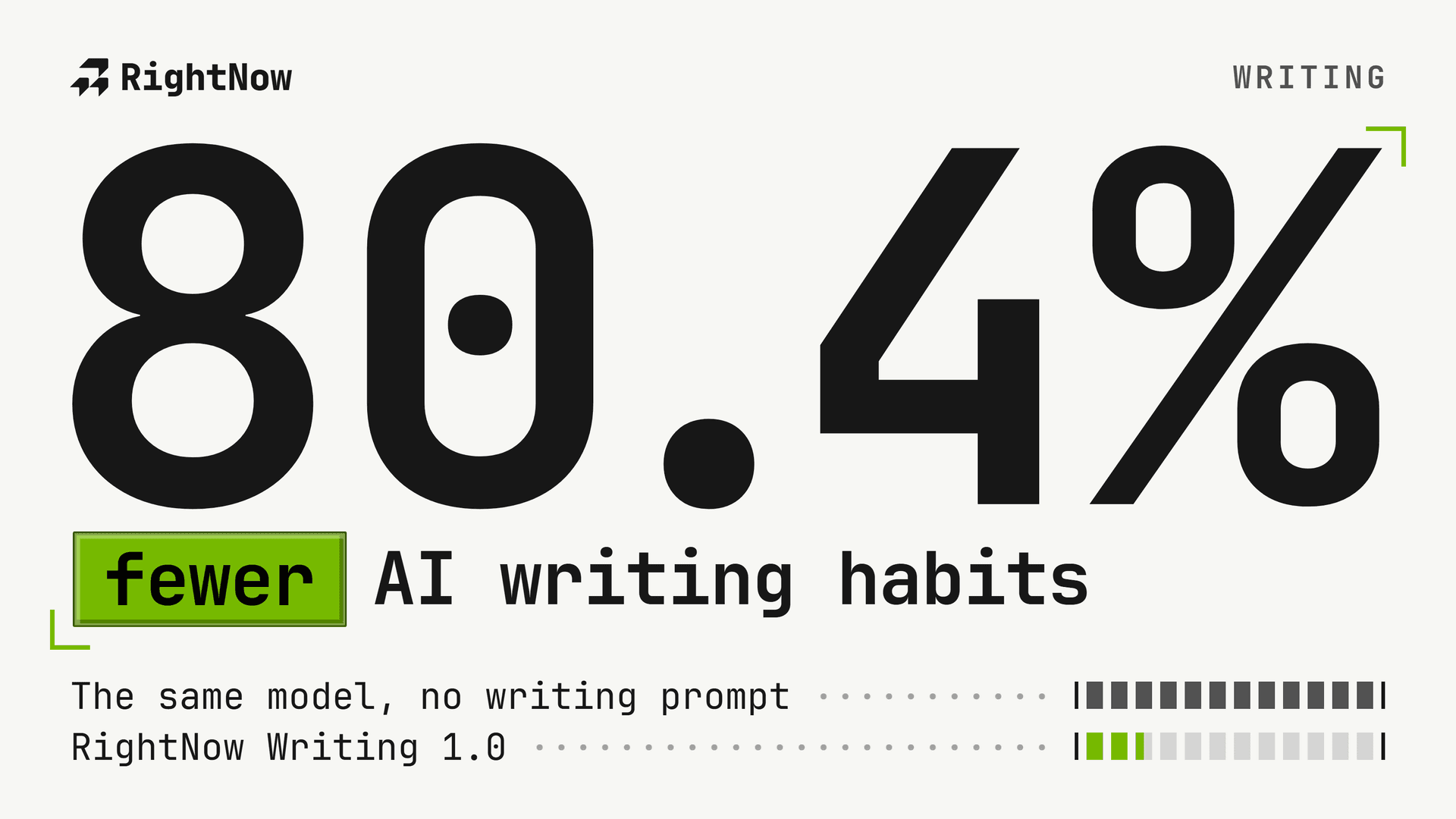
On the 36 fresh requests on 23 November, the model as it ships wrote 2.3 habits per 1,000 words, 80.4 percent fewer than the same model with no writing prompt. It wrote 0 em dashes. Every habit the counter still finds is a list of three.
Against other models
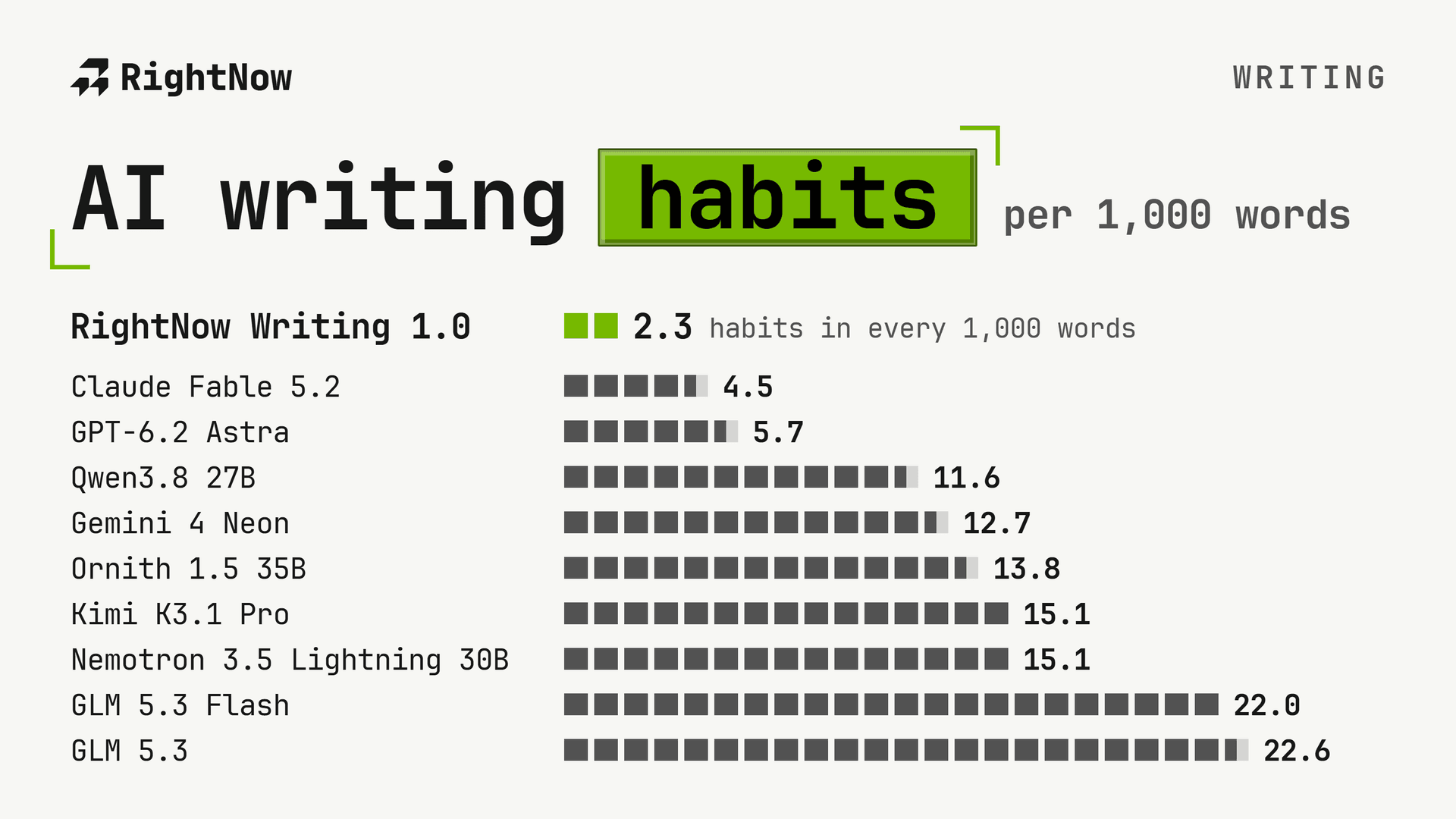
The same counter read nine named models' answers on 22 November.
| Model | AI writing habits per 1,000 words |
|---|---|
| RightNow Writing 1.0 | 2.3 |
| Claude Fable 5.2 | 4.5 |
| GPT-6.2 Astra | 5.7 |
| Qwen3.8 27B | 11.6 |
| Gemini 4 Neon | 12.7 |
| Ornith 1.5 35B | 13.8 |
| Kimi K3.1 Pro | 15.1 |
| Nemotron 3.5 Lightning 30B | 15.1 |
| GLM 5.3 Flash | 22.0 |
| GLM 5.3 | 22.6 |
Three of the nine were counted on 28 or 29 answers, because a few answers were missing or cut off.
Only the order holds up, since the request sets differ. A low count does not mean better writing either. The model at 22.0 took more requests than our first version in the panel below, 18 to 12.
That panel ran on 22 November, on the first version of our instructions with thinking on. Both have changed since, so it is two settings old.
It used 30 everyday requests, with one answer per model. No judge ruled on a pair holding its own vendor's model, and names were hidden with the order balanced.
The other models got the bare request with no style prompt. The judges read raw text, so Markdown counted against models that use it.
| Compared with | Writing 1.0, first version, preferred | Other model preferred | Not compared | Reads as |
|---|---|---|---|---|
| The same model with no writing prompt | 27 | 3 | 0 | Clear win |
| Nemotron 3.5 Lightning 30B | 26 | 4 | 0 | Clear win |
| Ornith 1.5 35B | 25 | 5 | 0 | Clear win |
| Qwen3.8 27B | 24 | 6 | 0 | Clear win |
| GLM 5.3 | 19 | 10 | 1 | Level |
| Kimi K3.1 Pro | 17 | 11 | 2 | Level |
| Gemini 4 Neon | 15 | 13 | 2 | Level |
| GPT-6.2 Astra | 14 | 16 | 0 | Level |
| GLM 5.3 Flash | 12 | 18 | 0 | Level |
| Claude Fable 5.2 | 9 | 21 | 0 | Clear loss |
Four rows clear the 21-win line. Five are level, two of them leaning the other way by too little to call. The last row is a clear loss, 9 requests to 21. The judge from our one-vendor panel's vendor was the kindest to us in several pairs.
We have not rerun this panel on version 11 with judges from three vendors. Later screens against some of these models had judges from one vendor only, so we leave them out.
What thinking is worth
On 23 November, two more blind AI judges from the same vendor as our bar compared answers with and without thinking on the bar's 40 requests. Both preferred the thinking answer on 21. Both preferred the answer with no thinking on 15, and they split on 4. Thinking helps a little.
To turn it on, send "reasoning_effort": "high". The thinking bills as output tokens and is not returned, so your output count will be larger than the text you see. Give it room in max_tokens. Our quality tests with thinking used a limit of 3,000.
Price, speed and what a call costs
| Per million tokens | USD |
|---|---|
| Input | 0.20 |
| Cached input | 0.02 |
| Output | 0.80 |
Every call carries the built-in prompt, about 2,300 input tokens. That adds about 0.046 cents a call, or about 0.0046 cents from the cache.
In ten runs of 512 output tokens on 23 November, one at a time and timed from outside our network, it wrote 198.2 tokens a second at the median, with the first token at 389 milliseconds.
In those runs 95.3 percent of prompt tokens came from the cache. That is the built-in prompt being cached, since it is the same on every call. It is not a rate to expect for your own long prompts. The model's page shows the same three figures.
How to call it
Send a chat completions request with the model set to rightnow-writing-1 and your key in RIGHTNOW_API_KEY.
The second call turns thinking on and leaves room for it in max_tokens.
For now the model takes 24 calls at once, so a "try again" answer during the launch means it is at that limit.
Who it is for
Start with story openings and social posts. In both outside checks the judges preferred it most there over the same model with no writing prompt.
As it ships, chat replies took 11 of 18 votes. Explanations and product descriptions took 9 of 18, exactly half, so try your own requests there.
Emails come last, at 4 of 18. The judges of the first check called its emails curt and short of a proper sign-off, so if your users expect a formal email, keep what you use now. We did not test support replies or rewriting a draft as kinds of their own.
Try it on the next thing you were going to write and then fix by hand. If a line still gives it away, send us that line through our contact page.