
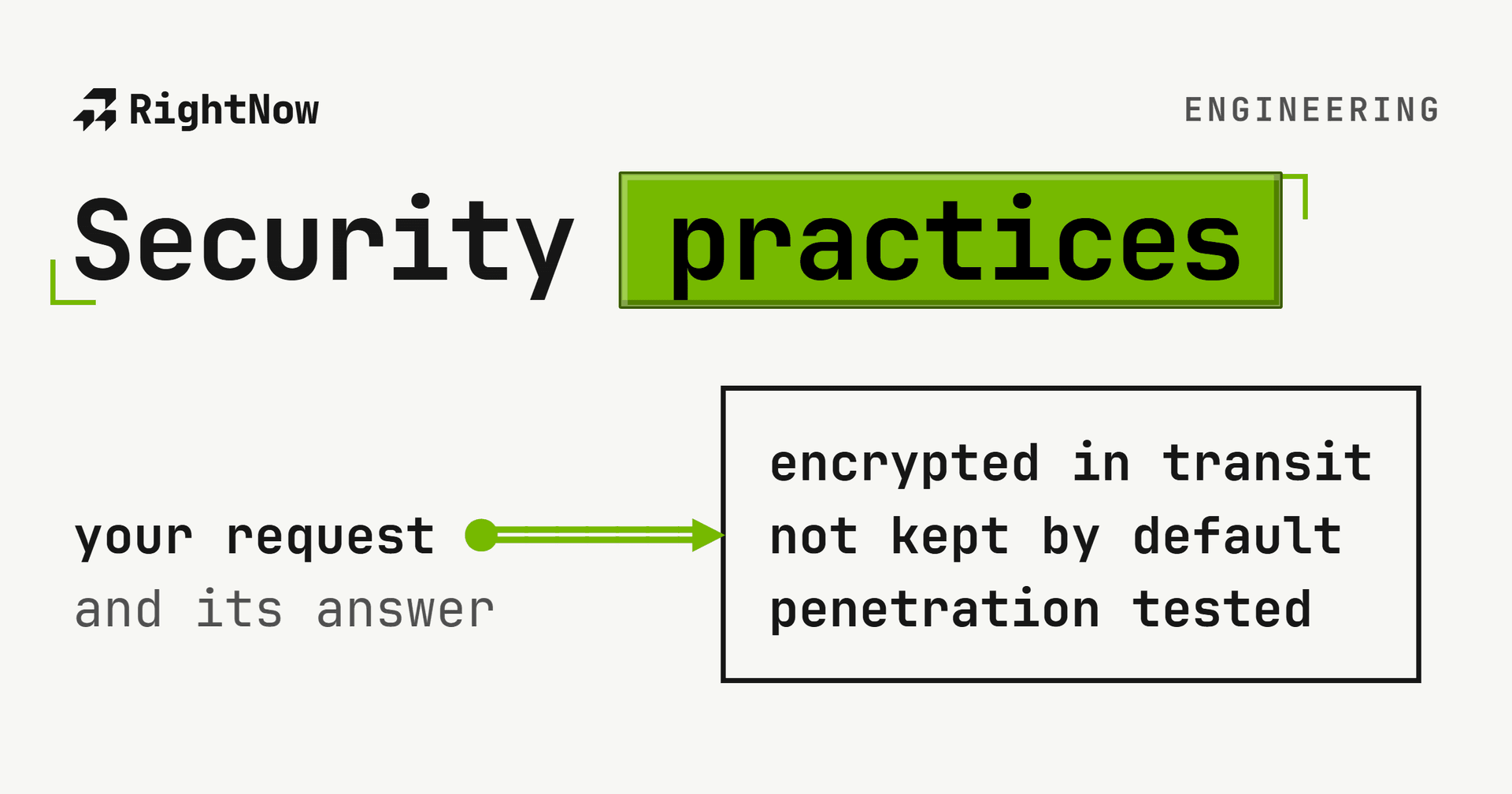
Security practices: how RightNow protects your data
, 5 min read, By Jaber Jaber
EngineeringRightNow AI runs production AI inference for customers who cannot tolerate downtime, data leaks, or silent model substitution. This page describes the controls, audits, and response processes we use to protect customer data and customer workloads.
Read on 28 November 2026. Each page quoted here is linked: check it before you decide.
How is my data encrypted?
In transit. All traffic to our websites, our API addresses and deployed inference endpoints is TLS 1.2 or higher. HSTS is enabled.
At rest. Object storage for the files you upload is encrypted at rest with AES-256 by its providers.
Secrets. API keys are never stored in plaintext. OAuth tokens are encrypted with AES-256-GCM. Application code accesses secrets through environment-bound secret managers, and secret scanning with push protection runs on our repositories.
Who can access my prompts?
Engineers do not access customer prompts or pipeline outputs in normal operation. When access is required to investigate an incident the customer reports, the access is logged, scoped to the relevant records, and annotated with the ticket number.
Sessions are scoped per workspace with role-based access control. Every API request is bound to one workspace by its key before it reads or writes a record.
Sign-in to our email, code hosting, our cloud, database and hosting consoles and the secrets vault needs a second step. Sign-ins to the GPU servers are recorded on each server.
Key, membership and billing changes, authentication failures and refused requests are recorded in a per-workspace audit log on every plan, kept while the workspace exists and deleted with it.
Do you keep my prompts?
The open models API is zero data retention by default. Our gateway's usage records are not given your prompt text. Neither are the log lines it writes while it handles your request, and a redactor cuts the request text it knows how to find in an error.
The service keeps per-request usage metadata, which is what billing and support need. The service does not train on your requests.
Content outlives a request only in windows you open: the model's output (a non-streamed response body, up to 6 MiB) for up to 24 hours when you send an Idempotency-Key, and audio uploaded through the large-file lane for up to 2 hours (no hosted model accepts uploads today).
An engine can print part of a request or of an answer to its local log on its GPU server, on an error or when it cannot read a tool call, where it stays until that log is rotated or removed.
A Dedicated deployment runs a model you choose on replicas held for your workspace. Zero data retention: we do not store your prompts or outputs. The Terms name the two limits that apply.
The Data retention guide lists what is kept and for how long, section by section.
Do you have a SOC 2 Type 2 report?
RightNow AI holds a SOC 2 Type II report with an unqualified opinion. SOC 2 Type II is an independent audit, conducted under AICPA standards, that evaluates the operating effectiveness of security, availability, and confidentiality controls over a defined audit window rather than at a single point in time.
Our report covers 1 January to 31 March 2026 and the inference platform we operated in that window. The hosted Model APIs and the GPU servers behind them were added after that window. They are in the scope of the SOC 2 Type II program we run today. No report on that scope has been issued yet.
The full report, with the auditor's identification, is available to current customers and to qualified prospects under NDA. Request it at security@rightnowai.co.
Is the API penetration tested?
The production API is penetration tested at least once a year. The penetration test of 22 October 2026 found no path that crosses between tenants. Its report can be shared under NDA with the tester's permission.
Remediation is prioritized by severity. Our targets are 30 days for critical and high findings, 60 days for medium and 90 days for low.
Changes to application code ship through pull requests. Automated checks run on each one, and pull requests to the API gateway and backend repositories get an automated security review. Dependencies are pinned with lockfiles.
How do you handle incidents?
Service health is monitored continuously with synthetic checks against the public API surface. Uptime monitors alert the on-call engineer by email. Application errors are captured by an APM that masks request bodies and headers known to contain secrets.
We maintain a documented incident response plan covering detection, triage, containment, eradication, recovery, and post-incident review. Severity is classified on a four-tier scale and drives the response timeline.
In the event of a Personal Data Breach affecting customer data, we will notify the affected customers without undue delay, and in any case within 48 hours of becoming aware of the breach.
The notification will identify, to the extent known at the time, the nature of the breach, the categories and approximate number of records concerned, the likely consequences, and the measures we are taking to contain and remediate.
After an incident that affects customers, we will send them a written summary with the timeline, root cause, and the corrective actions taken.
How do I report a vulnerability?
We welcome responsible disclosure of security vulnerabilities. To report a vulnerability:
Email security@rightnowai.co with a description of the issue, reproduction steps, and any proof-of-concept material.
Allow us a reasonable window to remediate before public disclosure (typically 90 days, shorter for actively exploited issues).
Do not test against customer data, deployed customer endpoints, or accounts other than your own. Do not perform DoS testing.
We commit to acknowledging receipt within 2 business days, providing a triage assessment within 5 business days, and crediting reporters where desired.
Where are your sub-processors listed?
Every sub-processor, with the data it handles, is listed in the Privacy Policy.
We do not use your API inputs or outputs to train any models or for any purpose other than providing the Services.
For the formal contractual version of these commitments, see the Data Processing Agreement and the Privacy Policy. For the legal-risk allocation, see the Terms of Service.
The Security page covers encryption, access controls, monitoring and incident response.