
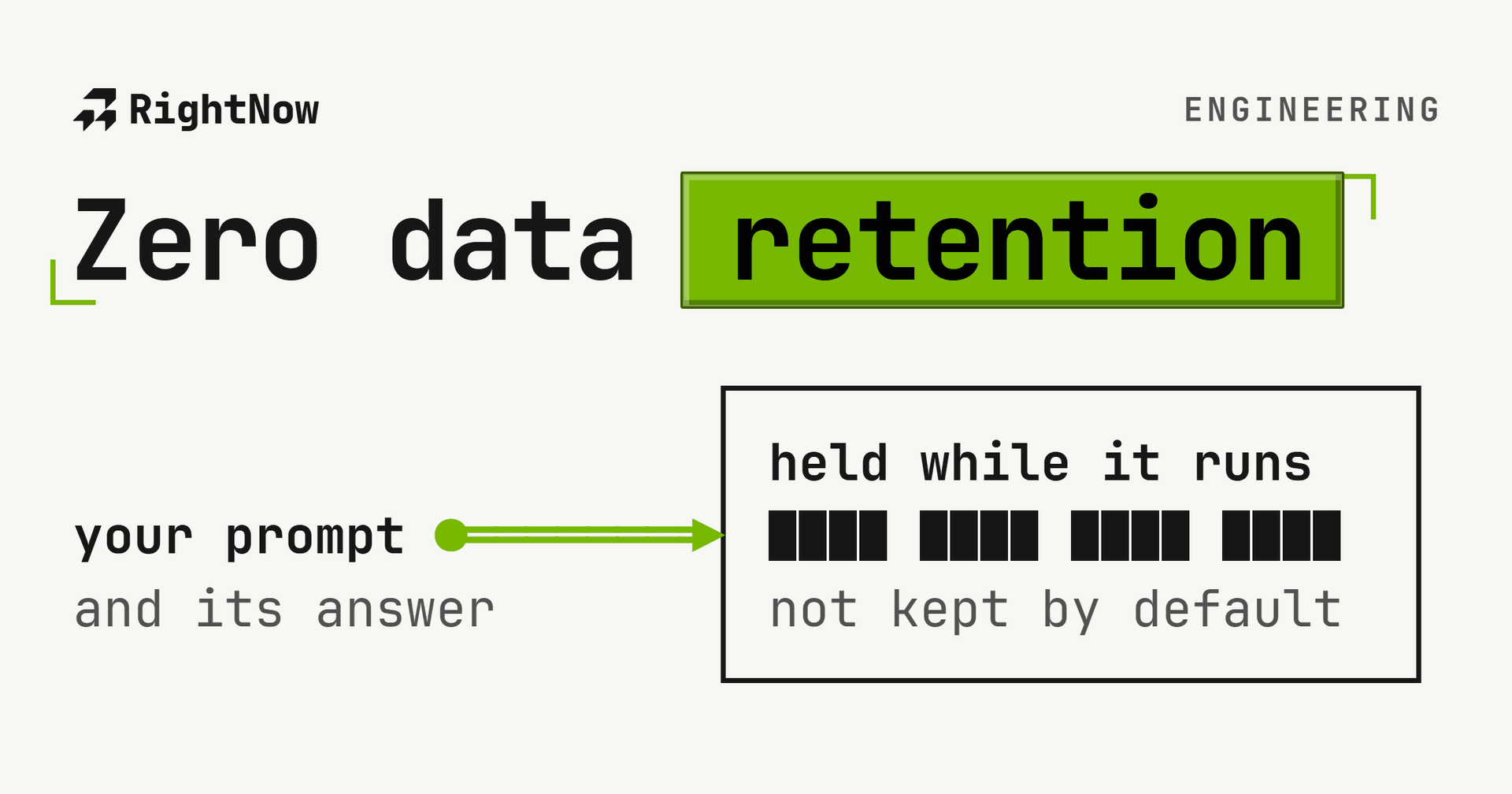
Zero data retention API: what we keep, and for how long
, 4 min read, By Jaber Jaber
EngineeringThis post answers the questions a security review asks any inference provider: what is kept about each request, for how long, and where it is published.
Do you store my prompts or outputs?
The open models API is zero data retention by default. Our gateway's usage records are not given your prompt text. Neither are the log lines it writes while it handles your request, and a redactor cuts the request text it knows how to find in an error.
The service keeps per-request usage metadata, which is what billing and support need. The service does not train on your requests.
Do you train on my requests?
No. We do not use your API inputs or outputs to train any models or for any purpose other than providing the Services.
What do you keep about each request, and for how long?
One usage record per request, plus the billing transaction that settles it. Between them they hold the token counts, the cost, the timing, the model called, the request id, the status, and the key and workspace ids. None of these values contains your content. Neither record receives your messages, your files, or the model's output.
Usage metadata, kept for 90 days, and longer only while a charge is not final or a batch or a decision record still refers to it. The billing record of each charge, with its model, token counts, status, latency, price, time and amount but never its content, is kept for 7 years as a financial record.
Records written up to 18 November 2026 can also still hold keyed one-way digests of the prompt, the system prompt and the tool definitions. The digests cannot be reversed into your text.
What stays in memory between requests?
Serving a request means holding it in memory for as long as the request takes. That is unavoidable, and it is the boundary of any inference provider's retention claim.
Repeated leading context is reused as a cached prefix, held only on the serving side and never written to our database, and it is what makes cached input cheaper than fresh input.
On every model where we publish a cached input price, cached prefixes in the gpu tier are isolated per workspace, so a prefix in that tier is only ever reused by the workspace that created it.
Can content outlive a request?
Content outlives a request only in windows you open: the model's output (a non-streamed response body, up to 6 MiB) for up to 24 hours when you send an Idempotency-Key, and audio uploaded through the large-file lane for up to 2 hours (no hosted model accepts uploads today).
Send no key and no response body is held. Streamed responses are never stored.
What can a log hold?
An engine can print part of a request or of an answer to its local log on its GPU server, on an error or when it cannot read a tool call, where it stays until that log is rotated or removed.
The Data retention guide lists what our logs, error reports and audit entries can carry, line by line. Zero data retention by default means no request or response content is stored unless you open one of the windows above, apart from the older records, error reports and logs described above.
What about a dedicated deployment?
A Dedicated deployment runs a model you choose on replicas held for your workspace. Zero data retention: we do not store your prompts or outputs. The Terms name the two limits that apply.
Can I send health data?
The open models API is not offered for protected health information today. HIPAA and a BAA are not available.
Do you have a SOC 2 Type 2 report?
RightNow AI holds a SOC 2 Type II report with an unqualified opinion. Our report covers 1 January to 31 March 2026 and the inference platform we operated in that window.
The hosted Model APIs and the GPU servers behind them were added after that window. They are in the scope of the SOC 2 Type II program we run today. No report on that scope has been issued yet. The Security page says how to request the report.
What should I ask a provider before I send customer prompts?
Ask each of these, and ask for the answer in writing:
Is my prompt or output written to any record, log or store?
Do you train on my requests?
What do you keep about each request, and for how long?
Does a cache hold my content between requests, and is it kept for my workspace alone?
When can content outlive a request, and who opens that window?
What can an error report or a log line hold?
Do the same terms cover a dedicated deployment?
Which audit report covers the service, and for what period?
Our answers are above. Retention terms in writing, for a procurement or compliance review, are a contract conversation. Contact us.
Where is all of this published?
The Data retention guide lists what is kept and for how long, section by section. The Security page covers encryption, access controls, monitoring and incident response.