
Zero data retention LLM APIs: what each provider keeps
, 7 min read, By Jaber Jaber
EngineeringThis page answers what a security review asks of every inference API: is zero data retention the default, and what is still kept? It covers ten providers in alphabetical order, RightNow AI among them.
Read on 28 November 2026. Each provider's own page is linked: check it before you decide.
Which inference providers are zero data retention by default?
These pages make zero retention, or no stored request content, the default:
Baseten: Model APIs, and synchronous requests to Dedicated Inference.
DeepInfra: inference requests, held in memory and not stored on disk.
Fireworks AI: open models, unless the user opts in to storage.
Groq: inference requests, though it may log them for reliability and abuse until you turn on zero retention.
RightNow AI: The open models API is zero data retention by default.
Together AI: new organizations.
Which providers offer zero retention as a setting or on request?
Amazon Bedrock: a retention mode you set per Region. A model that requires retention runs under zero retention only for an account approved for zero retention on that model.
Anthropic API: an arrangement you request from its sales team, per organization.
Google Gemini API: its page lists the steps to take and the features to avoid, and points workloads that need guaranteed zero retention to Vertex AI.
OpenAI API: eligible customers, with prior approval.
Does zero retention mean nothing is kept?
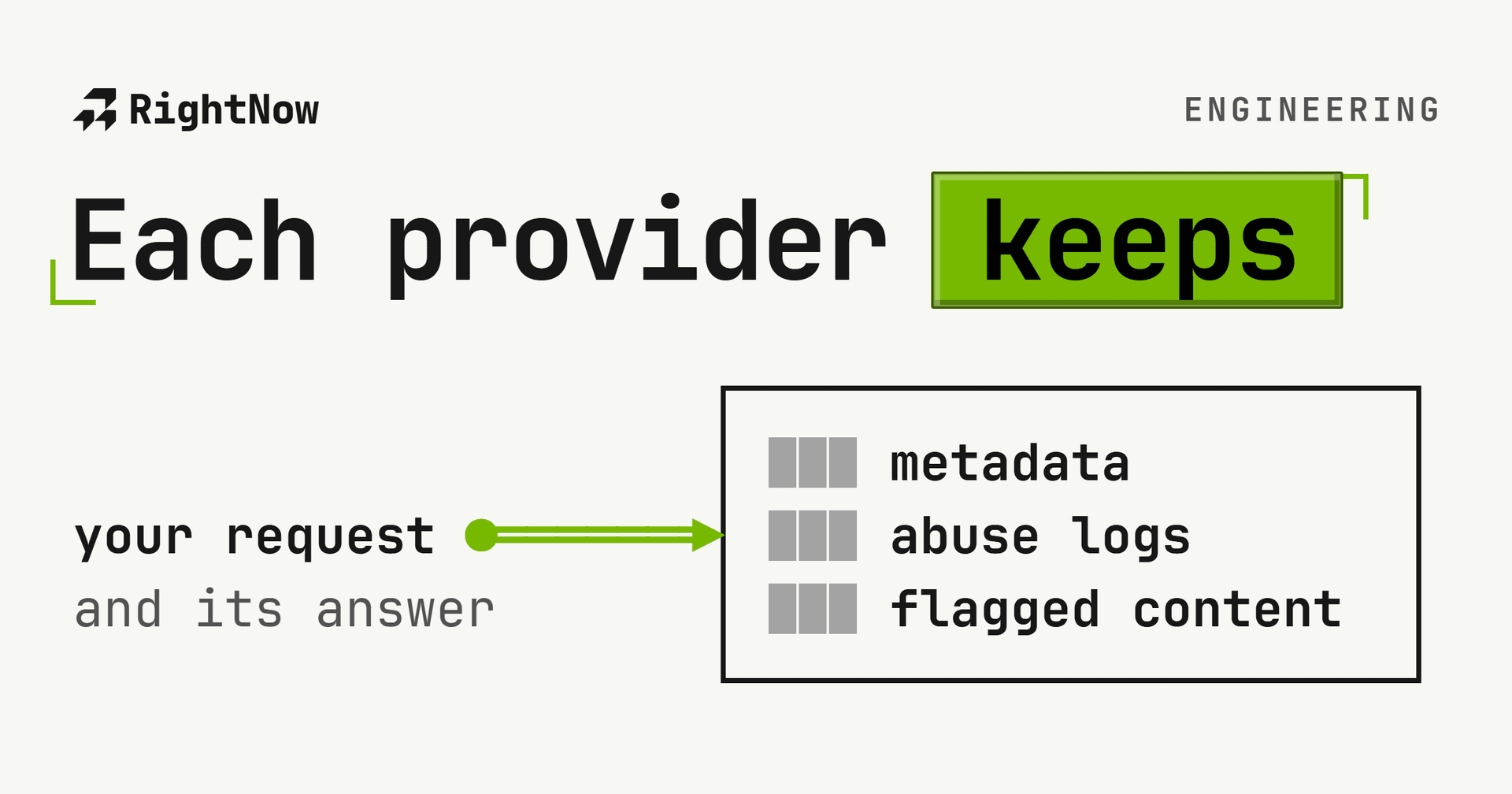
Zero retention on these pages is about request content: your prompts and the outputs. Several pages also name what stays. That can be request metadata, abuse or reliability logs, flagged content, or features that store data, such as batch jobs, uploaded files and stored responses. Ask each provider for the full list.
Which providers publish what they keep, and for how long?
Each of the ten has a public page. The table gives each page's default and part of what it names as kept. The sections after it give more detail.
| Provider | Zero retention | Can still be kept, per its page | Page |
|---|---|---|---|
| Amazon Bedrock | A mode you set per Region | Some models' traffic for up to 30 days, outside mode none | Data retention |
| Anthropic API | On request | Flagged content, for up to 2 years | API and data retention |
| Baseten | Model APIs, and synchronous dedicated requests by default | Training checkpoints until you delete them | Security |
| DeepInfra | Inputs held in memory only | Request id, cost and sampling parameters | Data privacy |
| Fireworks AI | Open models, without opt-in | Metadata such as token counts | Zero data retention |
| Google Gemini API | Steps listed, Vertex AI for guaranteed zero retention | Prompts and responses for a limited period | Zero data retention |
| Groq | Not retained by default, zero retention a setting | Reliability and abuse logs for up to 30 days, until zero retention is on | Your data |
| OpenAI API | Eligible customers, with approval | Abuse monitoring logs for up to 30 days | Data controls |
| RightNow AI (open models API) | By default | Per-request usage metadata, older records, error reports and logs | Data retention |
| Together AI | By default for new organizations | Request metadata and uploaded files | Zero data retention |
What does each provider's page say?
Amazon Bedrock
Amazon Bedrock's data retention page makes retention a mode you set per Region, for the account or for a project. In mode none, AWS writes no request or response data to durable storage. Where no mode is set, each model's own default applies.
In mode default, AWS may keep data for safety and abuse prevention. Its abuse detection page says that for some models it keeps flagged traffic, or all traffic, for up to 30 days. A model that needs retention is refused under none unless the account is approved for zero retention on that model.
Anthropic API
On Anthropic's API and data retention page, zero retention is an arrangement you request from its sales team, enabled per organization. Under it, Anthropic keeps no prompt or response at rest after the API returns its answer. The page calls this Legacy ZDR, and names a newer arrangement in beta.
Even under it, Anthropic may keep data where the law requires, and may keep inputs and outputs its automated trust and safety systems flag for up to 2 years. Features that store data, such as batch processing (29 days) and the Files API, are outside the arrangement.
Some models require 30-day retention and are not offered under Legacy ZDR unless Anthropic authorizes them.
Baseten
Baseten's security page says its Model APIs run under a zero data retention policy, with no inputs or outputs stored. On Dedicated Inference, synchronous requests get zero retention by default.
Still kept, per the page: checkpoints from training jobs, until you delete them. Its data handling section names no request metadata and does not speak of asynchronous requests, so ask what is logged and for how long.
DeepInfra
DeepInfra's data privacy page says request data is held in memory during inference and is not stored on disk, and outputs are deleted once sent back. It logs metadata for debugging: the request id, the cost and the sampling parameters.
The page names its exceptions. Image generation outputs are stored for a short period. Bulk inference may store data longer, possibly on disk in encrypted form, and deletes it a short period after the results are returned. With Google or Anthropic models, that company stores the output under its own policy.
Fireworks AI
Fireworks AI's zero data retention page says prompts and generations on open models are not logged or stored unless the user explicitly opts in. With prompt caching on, some prompt data can stay in volatile memory for several minutes. It logs metadata, such as token counts.
Outside the policy: the Batch API, which stores datasets, and the Responses API when store=True, its default, which keeps conversation data for up to 30 days. Enterprise admins can turn on a policy that rejects requests and jobs that would persist content.
Google Gemini API
The Gemini API's zero data retention page says that for paid services Google logs prompts and responses for a limited period, to detect violations of its Prohibited Use Policy. It points workloads that need guaranteed zero retention to Vertex AI.
The same page lists the steps to take and the features that keep data. Grounding with Google Search stores prompts and output for 30 days, with no way to turn that off. Uploaded files stay until you delete them or they expire.
Its abuse monitoring page says prompts, added context and responses are kept for 55 days, to detect and prevent violations of that policy.
Groq
Groq's data page says: "By default, Groq does not retain customer data for inference requests." It may log inputs and outputs for up to 30 days to troubleshoot reliability errors or investigate suspected abuse, unless the law requires longer. Any customer can turn on zero data retention, which stops that logging.
Usage metadata is always kept, without inputs or outputs. Batch files are kept for 30 days unless you delete them, and fine-tuning data until you do. With zero retention on, features that need stored data are turned off.
OpenAI API
OpenAI's data controls page says abuse monitoring logs are made for all API use by default and kept for up to 30 days, unless longer is required by law or needed to protect against harm. They can hold prompts and responses.
Zero Data Retention is for eligible customers, with prior approval by OpenAI. It removes customer content from those logs. Endpoints the page marks as not eligible can still store application state with it on.
RightNow AI
The open models API is zero data retention by default. The service keeps per-request usage metadata, which is what billing and support need.
Usage metadata, kept for 90 days, and longer only while a charge is not final or a batch or a decision record still refers to it. The billing record of each charge, with its model, token counts, status, latency, price, time and amount but never its content, is kept for 7 years as a financial record.
Records written up to 18 November 2026 can also still hold keyed one-way digests of the prompt, the system prompt and the tool definitions. The digests cannot be reversed into your text.
The Data retention guide's Scope section says: "Zero data retention by default means no request or response content is stored unless you open one of the windows above, apart from the older records, error reports and logs described above."
The open models API is not offered for protected health information today. HIPAA and a BAA are not available.
Dedicated deployments. Zero data retention: we do not store your prompts or outputs. The Terms name the two limits that apply.
Zero data retention API: what we keep, and for how long goes through each question a security review asks.
Together AI
Together AI's zero data retention page says: "Together AI enables zero data retention (ZDR) by default for new organizations." With it on, prompts and outputs are not stored or used for any secondary purpose. An organization that turned prompt storage on turns it off to enable zero retention, which covers only requests sent after that.
Still kept: request metadata such as token counts, model ids and timestamps, and account data. Files uploaded for fine-tuning or batch jobs stay until you delete them. Passthrough models are unavailable while prompt storage is off.
How do I check a provider's retention claim?
Read the provider's own page first. Then ask these questions, and get the answers in writing:
Is zero retention the default, a setting I turn on, or an arrangement I must request?
Which endpoints, features and models does it cover, and which does it leave out?
Do abuse monitoring or reliability logs hold my prompts, and for how long?
Which request metadata is kept, and for how long?
Can flagged content be kept longer, and who can review it?
Do batch jobs, uploaded files or stored responses keep my content?
Do requests routed to another company's model follow that company's policy?
Does the contract say what the public page says?
A page can change. Read it again before each review.